AI unlocks 80-year-old secrets of Einstein's friend, uncovers hundreds of mathematical discoveries
Researchers spent years studying Kurt Gödel's notebooks before AI analysed them in just two days
Published November 14, 2026
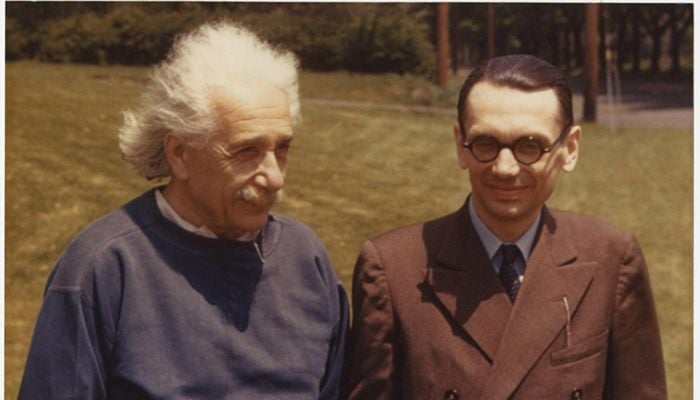
Nearly five decades after the death of Austrian mathematician Kurt Godel, artificial intelligence (AI) has uncovered hundreds of mathematical discoveries buried in his personal notebooks since the 1940s.
Godel, a close friend of Albert Einstein, is widely considered one of the greatest mathematical minds of the 20th century, whose work helped lay the foundations of modern computing.
However, much of his work remained unpublished, partly because he wrote his notes using an obsolete German shorthand called Gabelsberger.
A team of researchers led by Finnish logician Jan von Plato had been studying Godel's manuscripts since 2017.
After years of painstaking research, the team turned to Anthropic's AI chatbot Claude in September.
According to The Guardian, Claude produced a 650-page analysis of Gödel's work within days, identifying 663 potential mathematical theorems, approximately 400 of which were subsequently verified without corrections.
Did Godel miss out on mathematics' highest honour?
In 1966, American mathematician Paul Cohen received the Fields Medal, often described as the Nobel Prize of mathematics, for resolving fundamental questions concerning set theory.
Godel had previously demonstrated that certain mathematical assumptions were consistent with established mathematical rules. Cohen subsequently demonstrated that those assumptions could not be proved using those rules alone.
The newly analysed notebooks suggest Godel came remarkably close to one of Cohen's breakthroughs more than two decades earlier.
However, researchers caution that Godel's unfinished argument does not establish that he had actually proved the result.
Meanwhile, von Plato intends to explore Gödel's unpublished work on physics and cosmology, potentially uncovering further discoveries.