CDF Munir reaffirms resolve to eliminate terrorism, preserve hard-earned peace in KP
Field Marshal Munir visits Miran Shah, receives comprehensive briefing on prevailing security situation, says ISPR
Published November 20, 2026

- CDF Munir visits Miran Shah in North Waziristan: ISPR.
- CDF briefed on the security situation and IBOs: ISPR.
- COAS praises troops’ preparedness and professionalism: ISPR.
Chief of Army Staff (COAS) and Chief of Defence Forces (CDF) Field Marshal Syed Asim Munir visited Miran Shah in North Waziristan, where he received a comprehensive briefing on the prevailing security situation, ongoing intelligence-based operations and measures to consolidate the gains achieved through sustained counterterrorism efforts, the military’s media wing said in a statement on Friday.
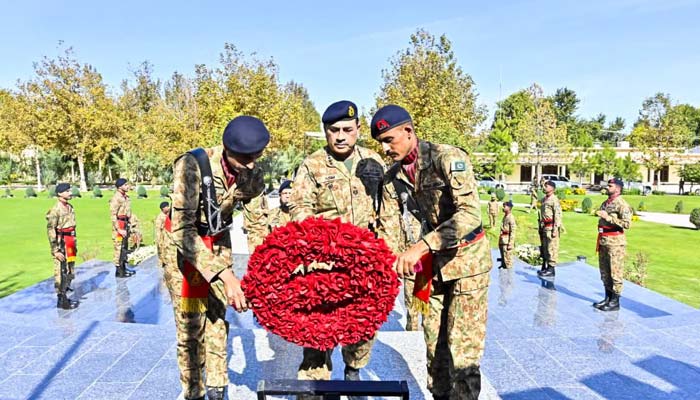
According to the Inter-Services Public Relations (ISPR), CDF Munir laid a floral wreath at Yadgar-e-Shuhada to pay tribute to the supreme sacrifices of the Pakistan Army's martyrs (Shuhada).
During the visit, he was briefed on measures being undertaken to ensure lasting peace and stability in the area.
CDF Munir also interacted with officers and troops and appreciated their high level of preparedness, professionalism and unwavering commitment to the defence and security of the country, the ISPR said.
The military's media wing said the army chief commended the police force in Khyber Pakhtunkhwa, describing it as a brave frontline force, and expressed pride in its resilience and sacrifices in the fight against terrorism and Fitna-al Khwarij.
"The Field Marshal reaffirmed the unwavering resolve of the security forces, in close coordination with law enforcement agencies (LEAs), to decisively eliminate the menace of terrorism and preserve the hard-earned peace and stability of Khyber Pakhtunkhwa," the statement added.
The Corps Commander Peshawar received the CDF upon arrival.
Pakistan has witnessed a surge in terror activities, particularly in its Khyber Pakhtunkhwa (KP) and Balochistan provinces, since 2021, when the Afghan Taliban came into power.
According to a report by the Centre for Research and Security Studies (CRSS), the two provinces remained the country's main hotspots for violence during the second quarter of 2026, with KP emerging as the worst-affected region.
The report stated that KP and Balochistan together accounted for nearly 96% of all violence-related fatalities recorded during the quarter. Of the total deaths, more than 61% (475) were reported in KP, while Balochistan accounted for 34% (265).
KP also recorded the highest number of violent incidents, with 151 cases, representing 57% of the nationwide total. Balochistan followed with 94 incidents, or 35%, underscoring the concentration of militant activity in the two provinces.